our method, written down
The motion that got you here lives in your head. Until it's written down and inspectable, nobody else can run it.
There are three parts to changing that.
the buyer
Not the user. Not the champion. The person who signs off and has to justify the spend.
part 1: define the buyer
Until now, your positioning has been living in your head. The first work is getting it out.
Who is your real buyer, who signs, not who uses it.
What problem they're solving.
What they need to hear before they will move.
Most founders can answer these questions in a room. Almost none have written them down in language a cold reader would recognise. That gap is where pipeline becomes unpredictable. It takes about a week to close it.
~ 1 week
To write down what's already in your head. Positioning and messaging that exists, just not on paper.
the output
A buyer definition. A problem statement. The language that moves them, before they know your product exists.
part 2: build the system
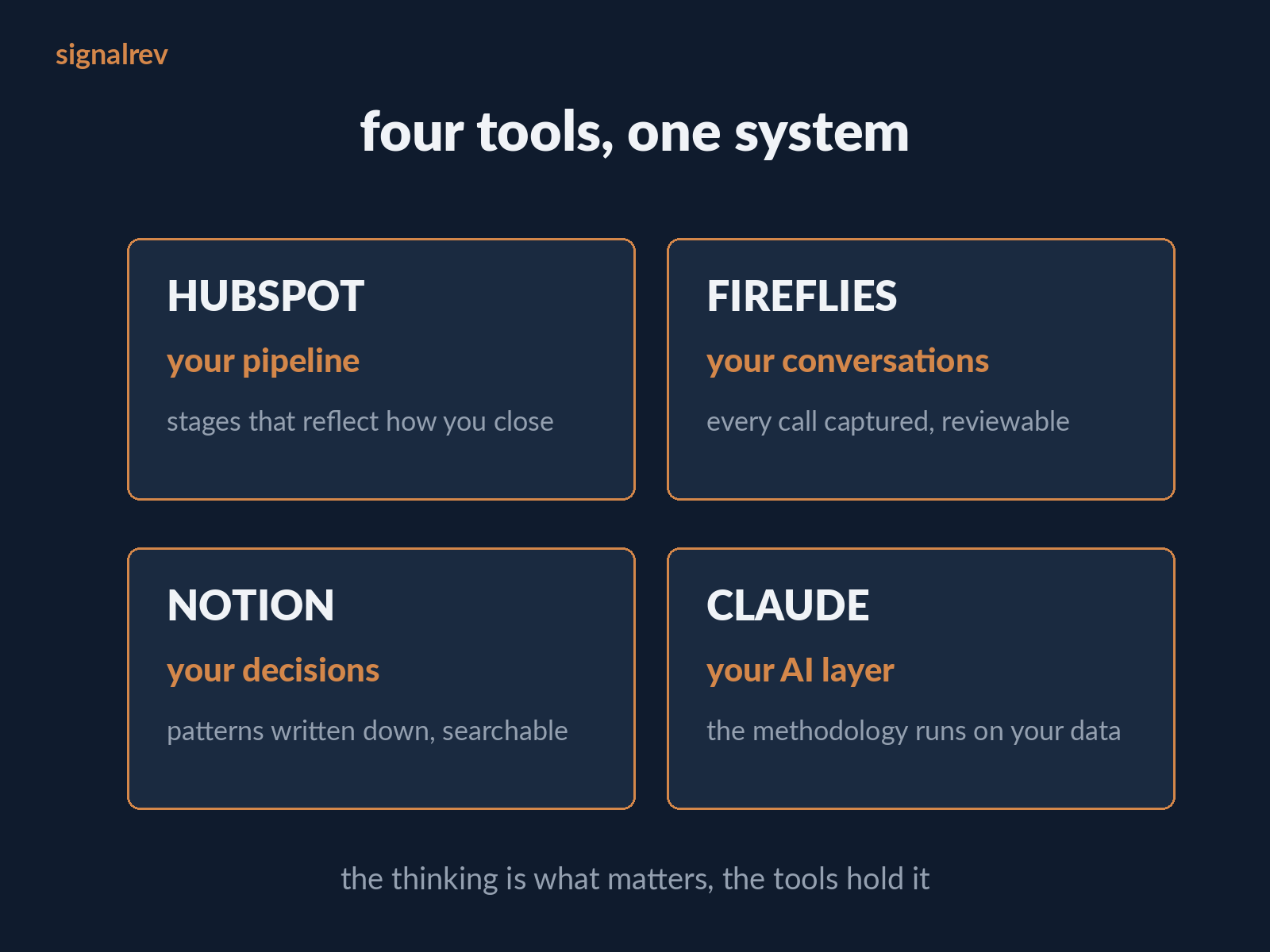
The knowledge of how your business reaches buyers should not live in your head. When it does, nothing is repeatable and nothing improves. What signalrev builds: your positioning, a buyer map, and four tools configured to hold them. Your pipeline (HubSpot). Your conversations (Fireflies). Your decisions (Notion). Your AI layer (Claude). By the end of week one the system exists. Your next hire inherits it.
01 / hubspot
Your pipeline
Stages that reflect how you actually reach buyers. Fields that capture what matters. Views that tell you what to do next.
02 / fireflies
Buyer conversations
Every conversation becomes a structured note. You see what you said, what they said, and what to do differently.
03 / notion
Buyer map + decisions
The patterns you spot and the calls you make stay in the system, not in your head.
04 / claude
Your AI layer
Reads your pipeline, conversation notes, and buyer map together. Surfaces what matters for the weekly review.
part 3: run the rhythm
A system that does not get used does not improve. The rhythm is not a meeting. It is the inspection layer.
Every week the system surfaces what moved, what didn't, and what to do next.
You review it. You make one call. The motion adjusts.
By day 90 you are running this yourself.
every conversation
Capture and review
One thing to improve, written down. You get better with every conversation because you can see what happened.
day 90
You're running it
The system is yours. Pipeline has real deals. You know what's working and what to adjust.
beyond
Monthly rhythm
The founders who stay continue. The weekly review is where the actual learning happens.
every week
one decision
The system surfaces what moved and what stalled. You look at the evidence and make one call. You leave with something to test.
what it requires from you
The system runs weekly. What it asks of you is one decision per week, made from evidence, not instinct.
The rest is captured automatically. You lead the motion. signalrev builds the system around it.
01 / one decision
Per week, made from evidence. Everything else is async and captured automatically. You're not blocked waiting for a call.
02 / you lead
The motion is yours. signalrev builds the system around how you already sell, not a new playbook from scratch.
03 / you own it
The system stays with you when the engagement ends. No lock-in. Your next hire inherits it.
One conversation, thirty minutes. If it's not the right fit, we'll say so.
30 minutes. No commitment.